
Economic inequality shapes society, influencing access to resources and opportunities. The intricate web of policies and systemic structures has long favored a select few, leaving many to grapple with the consequences. As we examine the layers of disparity, the impact on social justice and the role of government become crucial elements in understanding this complex issue.
Economic Inequality's Roots
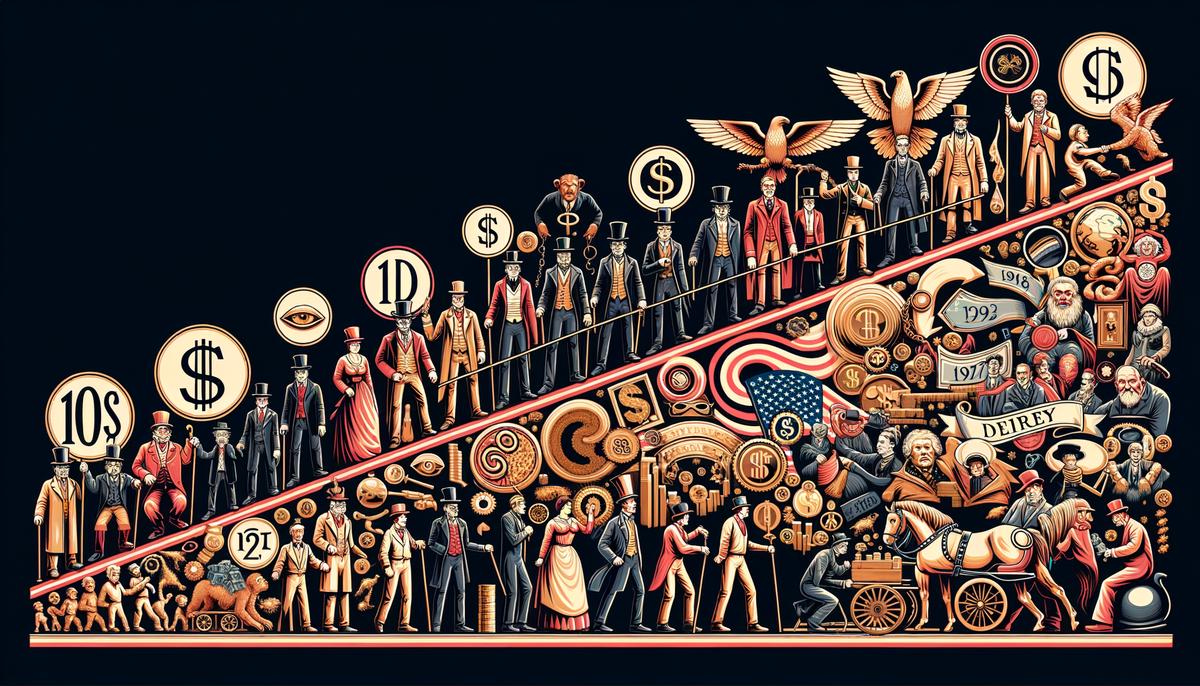
Economic inequality in the United States has deep historical roots. Policies and market dynamics established during the gilded age have created a system that often perpetuates disparities. From tax systems favoring the wealthy to significant wage gaps, the economic landscape has been tilted to benefit the top earners.
Policy decisions play a crucial role in shaping inequality. Progressive taxation, which should theoretically level the playing field, has been eroded to favor capital accumulators. Lower capital gains taxes benefit high-income earners disproportionately, while tax rates on the wealthiest have generally decreased over time.
The labor market contributes significantly to economic inequality. Worker wages have not kept pace with rising costs of living and inflation, while executive compensation has increased dramatically. The emphasis on shareholder value has often come at the expense of investing in the workforce. The decline of labor unions has left individual workers with less bargaining power against large corporations.
Racial disparities are deeply intertwined with economic inequalities. Historical practices like Jim Crow laws and redlining have had lasting repercussions, evident in current employment statistics and pay disparities. Many major cities exhibit stark contrasts between wealthy and impoverished areas, often along racial lines.
Housing inequality further exacerbates economic disparities. Real estate inflation has outpaced salary growth, limiting social mobility and contributing to neighborhood segregation. This impacts access to quality education, healthcare, and other essential services.
These factors combine to create a complex web of economic inequality that persists across generations. Systemic biases influence who has access to opportunities for prosperity, affecting American families' ability to meet basic needs while the ultra-wealthy experience little financial pressure.
Impact on Social Justice
Economic inequality significantly impacts social justice, affecting access to essential resources like education, healthcare, and housing. One's zip code can often determine life opportunities, creating an uneven playing field from an early age.
Education, often viewed as an equalizer, is distributed unequally due to property tax-based funding. Schools in affluent areas typically have more resources, while those in poorer regions struggle with basics. This educational disparity perpetuates a cycle where children from marginalized backgrounds enter adulthood with fewer opportunities.
Healthcare disparities follow a similar pattern. In a system where healthcare is not universally accessible, those with limited financial means often face prohibitive costs and limited access. The correlation between economic status and health outcomes is significant, with wealth often determining the quality and availability of medical care.
Systemic discrimination compounds economic disadvantages, particularly affecting racial and ethnic minorities. Black and Latino communities face both economic barriers and challenges within the justice system, often limiting life opportunities and perpetuating disadvantage.
Housing inequality reflects and amplifies these challenges, influencing neighborhood boundaries, access to services, and public safety. Redlining and gentrification have long-term effects on community development and individual opportunities.
The psychological toll of economic inequality is substantial. Financial stress can lead to chronic anxiety and depression, affecting educational achievements, career progression, and overall resilience. This creates another layer of inequity, impacting mental health and well-being.
Addressing economic inequality requires more than surface-level solutions. It calls for a transformation of systems that dictate opportunity distribution, recognizing the interconnected nature of economic and social injustices.

Role of Government and Policy
Government plays a pivotal role in shaping economic inequality through taxation, welfare programs, and labor laws. These tools can either bridge gaps or deepen existing divides, depending on their implementation and enforcement.
Taxation, intended to redistribute resources, often falls short due to loopholes and inconsistencies. While progressive taxation aims to tax higher incomes at increased rates, deductions and capital gains tax caps often result in lower effective rates for the wealthiest individuals. This system often perpetuates wealth concentration rather than alleviating disparities.
Welfare programs, designed to provide a safety net, sometimes struggle with administrative inefficiencies and social stigma. Bureaucratic complexities can hinder access for those in need, while negative perceptions can impact the dignity of recipients. Underfunded initiatives often cover only basic needs, making it difficult for individuals to escape economic hardship.
Labor laws, another government tool for promoting fairness, require robust enforcement to be effective. Minimum wage laws, fair labor standards, and anti-discrimination measures provide frameworks for workplace equity, but without proper implementation, their impact is limited. The ongoing struggle for a living wage highlights the gap between legislative intent and real-world outcomes.
The decline in union influence, partly due to state and federal legislation weakening collective bargaining, has contributed to widening disparities between executive and worker pay. This trend underscores how political decisions can impact income distribution.
Political influence plays a significant role in shaping economic policies. Corporate lobbying often results in legislation that preserves wealth concentration rather than promoting broader distribution. This hidden aspect of inequality highlights the need for greater transparency and accountability in the political process.
Addressing these challenges requires a reimagining of government's role. Policies should focus on genuine equity, closing tax loopholes, enhancing welfare programs to foster advancement, and rigorously enforcing labor laws. Government action should aim to dismantle entrenched power hierarchies and create structures that provide universal opportunities.
Effective change demands not just legislative action but societal resolve. It requires a shift from symbolic gestures to substantive advocacy for all citizens, working towards a future where economic inequality is the exception rather than the norm.

Case Studies of Inequality
From the high-rises of New York to the scarcely populated corners of Appalachia, the U.S. wealth gap divides not just geography but lives and opportunities. This economic divide manifests in stark contrasts across the United States and reverberates globally.
In the corporate world, the gap between top-tier executives and average workers continues to widen. According to a study by the Economic Policy Institute, CEO pay skyrocketed by 1,322 percent between 1978 and 2020, while typical worker compensation rose just 18 percent.
State-level disparities are equally pronounced. California, often seen as a hub of innovation and prosperity, grapples with significant inequality. In Los Angeles, affluent neighborhoods exist in close proximity to areas of extreme poverty and homelessness. Conversely, states like Mississippi and Louisiana face high poverty rates, illustrating a nation divided not just by income but by access to education, healthcare, and upward mobility.
On the global stage, economic inequality affects billions. The divide between the Global North and Global South persists, with wealthier nations accumulating wealth often at the expense of poorer countries. This perpetuates cycles of dependency and economic stagnation. The contrast between countries like Norway, with high GDP and equity, and nations like South Sudan, where poverty and conflict prevail, is stark.
Global economic inequality is particularly evident in the face of crises such as climate change. Wealthier nations have resources to mitigate environmental disruptions, while the world's poorest communities bear the brunt of climate calamities. This imbalance reinforces and exacerbates existing inequalities.
Some nations have made strides towards more equitable wealth distribution. Scandinavian countries, with their comprehensive social welfare systems and innovative taxation policies, offer examples of more balanced economic frameworks. However, scaling these models globally remains a complex challenge, requiring cross-border cooperation and sustainable development strategies.
Addressing economic inequality requires more than acknowledgment. It calls for transformational strategies that go beyond temporary fixes, demanding policy shifts and societal change to create a future where opportunities are shared more equitably across all landscapes, domestic and international alike.
Strategies for Change
Addressing economic inequality requires a multifaceted approach, combining policy reforms, community initiatives, and international cooperation. This complex issue demands solutions that are both broad in scope and sensitive to local needs.
Policy Reforms
- Revise tax codes with an emphasis on equity
- Implement truly progressive taxation
- Close loopholes that allow the wealthy to avoid their fair share
- Ensure capital gains are taxed comparably to wages
- Adjust corporate tax rates
Welfare programs need reimagining to serve as catalysts for societal advancement. Integrating comprehensive support for education, healthcare, and community infrastructure, alongside strategies like universal basic income, could redefine social safety nets. These programs should aim to nurture personal development and autonomy, transitioning from mere survival mechanisms to vehicles for empowerment.
Labor laws must be strengthened to reaffirm workers' rights and enhance job security. Ensuring living wages, combating exploitative practices, and revitalizing labor unions can empower workers and encourage fair compensation. Promoting cooperative business models, such as the Mondragon Corporation, could reduce economic precarity by giving workers shared ownership.
Community-led Initiatives
Community-led initiatives are vital for localized transformation. Empowering neighborhoods to develop and implement solutions tailored to their unique challenges allows communities to thrive on their own terms. Examples include:
- Local cooperatives
- Community land trusts
- Time banking systems
- Local renewable energy projects
International Cooperation
International cooperation is essential for addressing global inequality. Collaboration on the world stage is necessary for:
- Pooling knowledge and resources
- Crafting fair trade policies
- Developing climate action strategies that balance economic and humanitarian needs
- Reforming international financial institutions to alleviate debt burdens on developing nations
Global platforms can facilitate technology transfers that equip under-resourced countries to adopt sustainable practices. Combining global insights with local wisdom can produce effective solutions that are globally inspired but locally relevant, building resilience against global shocks while nurturing local prosperity.
Addressing economic inequality is a complex challenge that requires rethinking how systems operate across policy, community, and international levels. It demands both pragmatic strategies and idealistic aspirations to pave the way for a more equitable future.

At its core, economic inequality is more than just a financial imbalance; it is a barrier to opportunity and equity. Addressing this challenge requires a concerted effort to rethink policies and societal structures, striving for a future where fairness is not an aspiration but a reality. By confronting these disparities, we can move closer to a world where prosperity is shared and accessible to all.